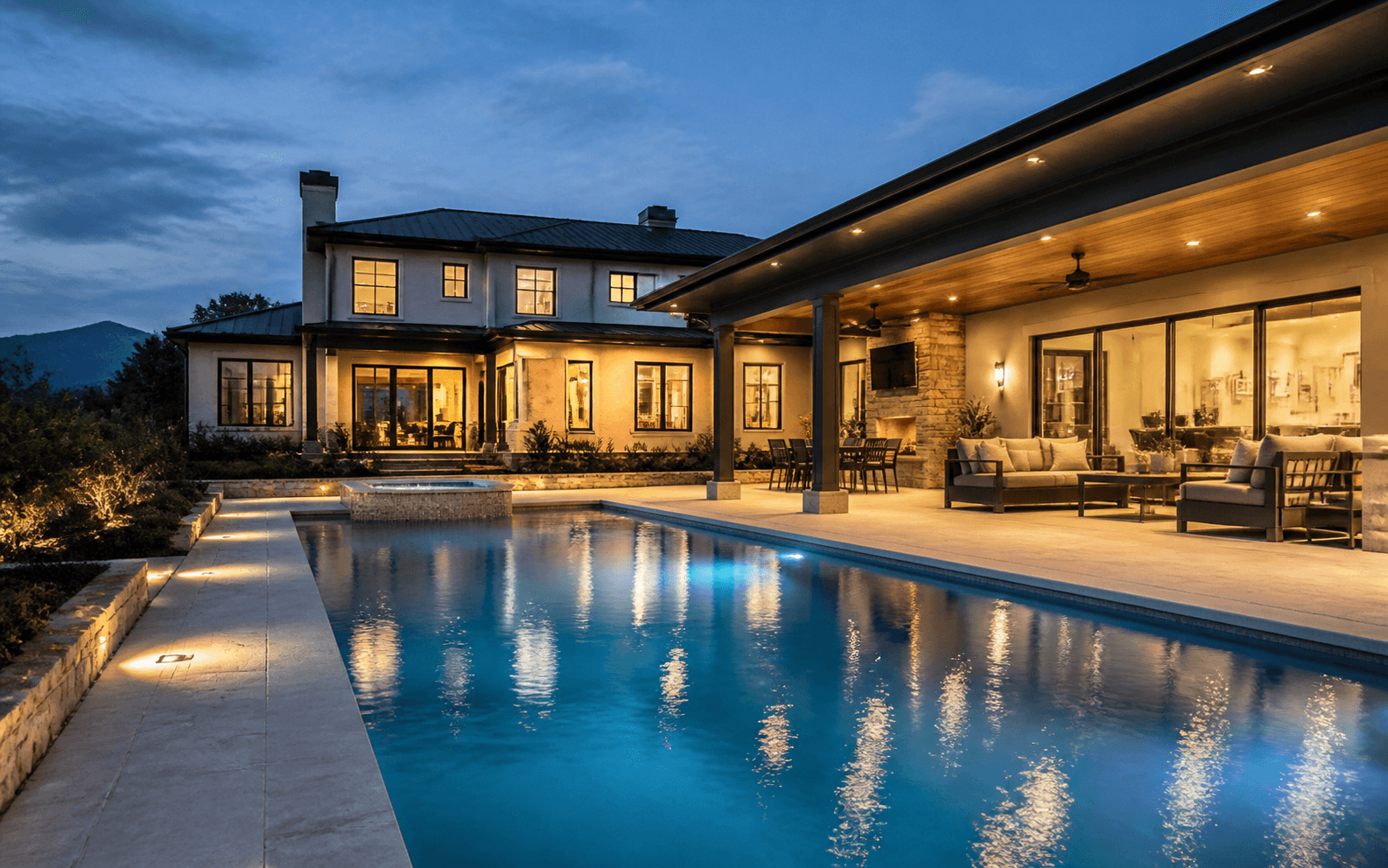
Get there before sunset so you can tidy the pool area, test the lights and pick your angle. Take a daylight shot first, then repeat the same composition as the sky darkens. Watch the pool steps, bright lights and reflections as closely as the colour of the water.
In this guide
Prepare the pool, patio, and view
Pools and outdoor spaces have more reflections, lights and seasonal detail than the front of a house. Get all the prep done before sunset, so you spend the twilight window on exposures, not cleaning up.
Clean the waterline
Take out leaves, pool cleaner hoses, toys, covers, towels and any maintenance gear. Run the pumps early enough that the surface has settled.
Show a usable layout
Straighten the furniture, open umbrellas only if it's safe, clear away food and personal things, and keep the paths clear.
Test every fixture
Check the permanent lamps, pool lights, garden lights, fire features and switches before it gets dark.
Photograph the season as it actually is. A closed pool, furniture in storage, dormant plants, snow or a cover you can see might change what you can honestly show. Don't rebuild summer in editing when the property looks quite different right now. Cleaning up temporary debris is one thing. Adding a pool, extending a deck, replacing permanent fixtures or hiding damage is another. Keep an accurate original to check against.
Choose an angle with water, access, and architecture
Start with a safe wide shot that shows how the pool or patio connects to the house. Keep the waterline level, the verticals straight and enough foreground to see how you'd safely get there. Once you've got that, add an angle built around the view, a lower shot near water level and one tighter lifestyle detail.
| Angle | What it explains | Watch for |
|---|---|---|
| Corner wide | The pool shape, patio, house and paths all together | Too much empty deck, or standing near an unprotected edge |
| Along the waterline | The reflection, the length and what's beyond it | Distorted architecture and a cut-off pool edge |
| From the house | How inside meets outside, and the view | Reflections in the glass and a dark foreground |
| Amenity detail | The fire table, dining area, spa, pergola or outdoor kitchen | A generic crop that loses where you are |
Keep shooting as the sky darkens
The exact time changes with your latitude, the season, the weather, which way the house faces and what's around it. Go by how balanced it looks, not a set number of minutes. Start while the house and deck still have natural detail, and keep going until the lights get too bright or the surroundings lose their detail.
I usually photograph the front exterior first and leave the pool area a little longer, so the pool and landscape lights have time to show. On larger properties, I try to finish the general photo and video coverage during golden hour, then save the short blue-hour window for the best exterior, pool and view compositions.
Move through the light without missing the pool
Pick each stage to see what matters before the light moves on.
Secure the safe frame
Lock in the composition, verticals, waterline, furniture and safety, and get a clean full-resolution shot before the light starts changing fast.
Control water colour and reflections
Pool water isn't just a flat blue shape. It reflects the sky, the house, the plants and the lights, depending on your angle, and it also shows its own finish and the underwater light. A believable photo keeps all of that.
The water usually deepens as the sky cools, but it shouldn't end up more saturated than everything around it.
Rooflines, posts, windows, trees and pergolas in the reflection should match the real scene and your camera angle.
Underwater and garden lights make contained highlights. They don't make the whole pool glow evenly.
- Be careful with a circular polariser. It can kill useful reflections, and it costs you light at dusk.
- When you want a clean reflection, wait for splashes and ripples from the cleaning system to settle.
- Check the water edges, railings, glass fences and wet stone at 100% for halos or doubled lines.
- Keep the pool finish believable. Turquoise plaster, dark tile and natural water shouldn't all end up the same blue.
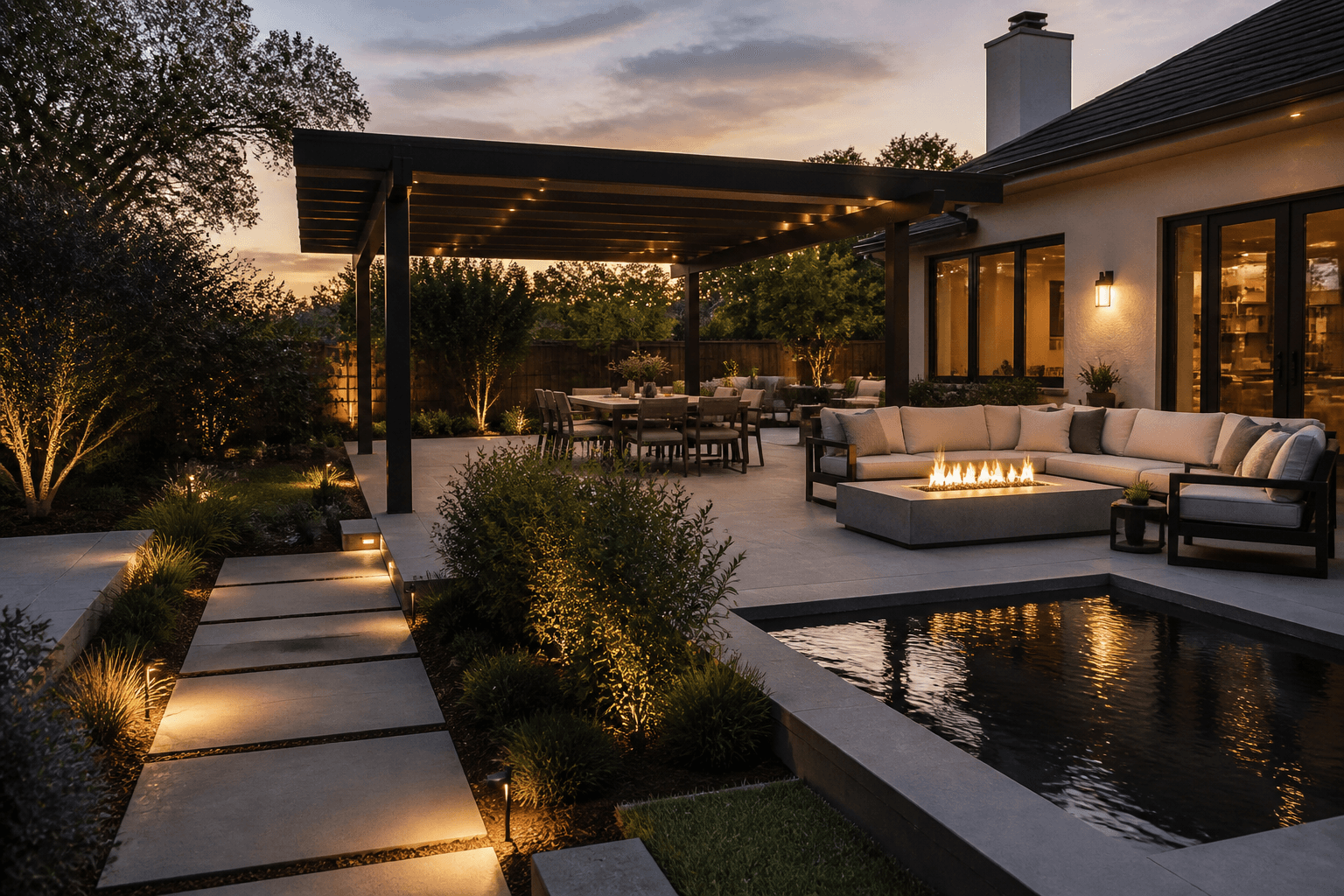
Balance pool, patio, and fire-feature lighting
Turn the permanent lights on early and photograph them as the daylight drops towards their brightness. Take frames with the lights both on and off when you can. Set a fixed white balance or shoot RAW so the sequence doesn't shift colour frame to frame. Different fixtures will still vary in colour. Fix a distracting cast, but don't force every light into the same orange.
Expose so the light keeps its shape and the water around it fades off gradually.
Use them to show the seating, steps and architecture, not to make random glowing patches.
Keep the bright centre from blowing out, hold the stone and furniture around it, and keep the flame modest.
Let the rooms support the outdoor shot without turning into solid orange rectangles.
Adjust exposure as the light changes
Use a tripod, a low ISO where you can, a middle aperture that suits the scene, manual focus once you've confirmed the important plane, and a remote or timer. As the light drops, slow the shutter before you raise the ISO. Bracket when the fire, lights, sky and shadows won't fit in one frame.
Hold the sky and bright parts of the house while keeping the overall detail.
Open up for the furniture, plants, stairs, dark siding and covered areas.
Shorten the exposure for lamps, flames, windows and bright underwater lights.
Take a version with the lights or flame off without moving the tripod.
Check sharpness again after anyone walks past, the deck vibrates, the wind picks up or you touch the tripod. Moving water can look natural, but the architecture has to stay crisp.
Work safely around water, flame, darkness, and electricity
Keep tripod legs and bags out of walkways, stay back from pool edges, and only use outdoor-rated lighting and protected power. Keep cords away from water, never move or service pool equipment for a photo, and follow the manufacturer's instructions for every fire feature.
- Walk the route in daylight and note the steps, pool edge, glass fences, slopes and anything low you could trip on.
- Use a headlamp between exposures, but don't shine it into a frame you're shooting.
- Have the owner or someone qualified run the pool systems and gas appliances.
- Don't stand on furniture, a wet pool edge, rocks, railings or loose landscaping to get an angle.
- Keep children, pets, clients and crew away from the tripod and gear.
- Call it a day when you can't see well enough, or the weather makes moving around unsafe.
A strong daylight source can become a virtual alternative
Weather, access, the schedule, a broken light or missing the twilight window can all rule out a real evening shoot. A clean daylight photo can still work for virtual twilight if it already clearly shows the real pool, patio, furniture, house, garden and view.
| Good virtual source | Weak or misleading source |
|---|---|
| A sharp full-resolution file with clear water edges and detail on the house | Blur, black shade, blown reflections or heavy compression |
| The real permanent fixtures, where they actually are | A request to add pool lights, a fire pit, a spa, a view or an outdoor kitchen |
| The current season, furniture, garden and condition | Old construction, missing fences, hidden damage or staging that's very different now |
| One safe wide shot plus another crop | A tight detail with nothing to show where it is |
Check the finished image against the original at thumbnail size and full size, and keep the original.
Use your best daylight pool or patio photo to compare three evening styles, without adding anything that isn't there.
Pool and outdoor twilight FAQ
What is the best time to photograph a pool at twilight?
Start before sunset and keep shooting through early dusk and blue hour. The best frame usually comes when the sky, the water, the house and the permanent lights are close enough in brightness to all keep their detail.
Should pool lights be on for twilight photos?
Usually, yes, if they're permanent and working properly. Turn them on before the light changes, but take a frame with them off too. Don't let one bright underwater light take over the exposure.
How do I keep pool water from looking neon blue?
Expose for the real balance of sky, water and lights, don't push the saturation, and check the reflections at full size. The water should pick up believable colour from the sky, the pool finish and the lights around it.
Do I need exposure brackets for a pool at dusk?
Brackets help when the sky, the house, a fire feature and the underwater lights won't fit in one exposure. Keep the tripod still and shoot a deliberate sequence, rather than changing the composition between frames.
How should I photograph a firepit or fire table?
Use the lowest safe flame that still shows up, keep the bright centre from blowing out, keep anything flammable well away, and never set up something unsafe for a photo. Take a frame without the flame in case you need to blend exposures.
Can a daylight pool photo be converted to virtual twilight?
Yes, if the photo is sharp, well exposed and accurately shows the pool, garden, furniture and permanent fixtures. Virtual twilight can change the mood. It shouldn't add a pool, fire feature, lighting, a view or architecture that isn't there.